


I recently watched Born to Be Viral on Hulu.
I’m a former child performer. I worked in this industry from age 8 to 30. And I’m telling you, as someone who survived the pre-internet version of what these kids are living through: it’s worse now. It’s so much worse now.
Not because the parents are worse. Not because the kids are weaker. Not because the world is meaner.
Because the scale is different. The protections are gone. And the cameras never turn off.
I want to talk about what nobody in that documentary said. What I wish someone HAD said. Because in 10-15 years, when these kids are sitting in a therapist’s office, the things they’ll be trying to make sense of are the things the documentary couldn’t quite name.
Let me name them now.
The kids on those channels are not having fun.
I want to start there because that’s the lie the whole machine runs on. The defense parents reach for first. “They love it. They ask to do it. We only film when they’re having fun.”
I know that defense. I lived inside that defense. My parents weren’t bad people. They believed every word of it. Most of these parents do.
Here is what I can tell you, from the other side of it, about what “they love it” actually means when you are 6, or 8, or 10 years old:
Loving it means being praised for it.
Loving it means feeling chosen for it.
Loving it means the adults in your house light up when you do it.
Loving it means you get treated differently from your siblings when you do it.
Loving it means it is the one thing that reliably gets you noticed.
A child saying “I love it” is not informed consent. It is a kid telling you they have figured out the equation. Performance equals love. That’s not joy. That’s survival adaptation dressed up as enthusiasm. The kid you are watching on TikTok is not auditioning for a role. They are auditioning for their parents.
And the camera you keep filming with is not capturing their childhood. It is replacing it.
There is no off-set.
The thing that broke me, watching the documentary, wasn’t any single moment. It was the ambient truth running underneath every scene: these kids do not have a backstage.
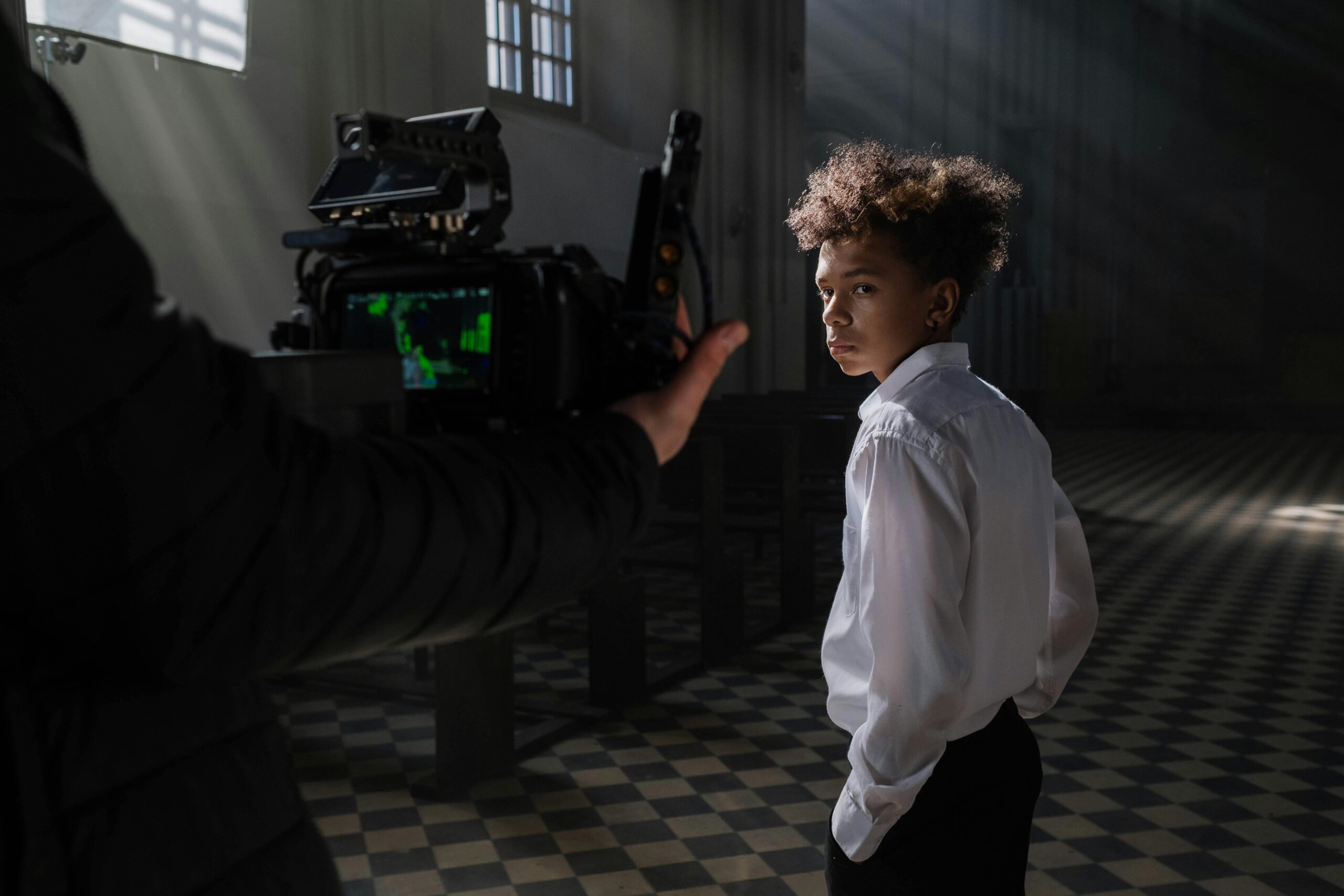
When I was on on stages, there was a wrap. There was an ending. There was a moment when the lights went off and the adults stopped looking at me and I got to go be a kid again, even if “being a kid again” only meant using a Sit & Spin while eating a Lunchable.
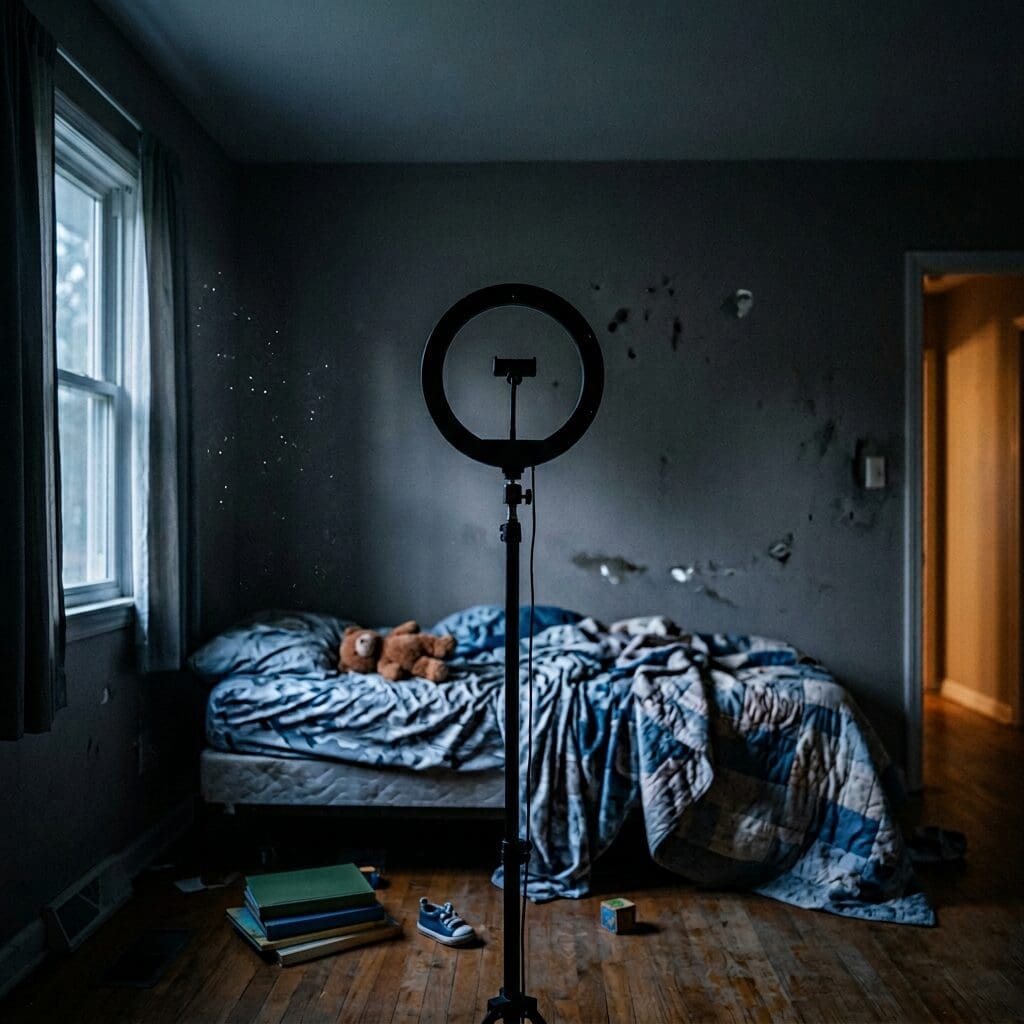
The kidfluencer kids do not get that. The kitchen is the set. The bedroom is the set. The bathtub is the set. The breakdown is the set. The grandparent’s funeral is the set. The puberty is the set. The first heartbreak is the set.
There is no wrap. There is no trailer. There is no moment where the adults stop looking. The audience is in their pocket. The audience is in their parents’ eyes. The audience is in their own internal monologue by age 7.
In fifteen years, these kids are going to be trying to figure out who they are when no one is watching. And the answer is going to be terrifying, because they have never been alone. Not once. Not really. The version of themselves that exists outside of being content was never given a chance to develop. That’s what they will be paying a therapist to help them excavate.
Coogan Law cannot save these children.
Let me say this clearly because the documentary danced around it and I don’t have to: the entire legal framework that exists to protect child performers in the United States does not apply to these kids.
Coogan Law was built for film and television. It mandates a percentage of a child performer’s earnings be set aside in a trust. It governs work hours. It requires on-set teachers. It limits what a parent can do with a kid’s labor.
A nine-year-old with twelve million followers on TikTok is not, legally, a child performer. They are a child whose parent is a content creator. The parent owns the channel. The parent owns the revenue. The parent owns the brand deals. The kid owns nothing. The kid is, in the eyes of the law, just helping out around the house.
This is not an oversight. This is a loophole the size of an entire industry, and that industry is making billions of dollars off the unpaid, undocumented, unregulated labor of children. The fact that we have not yet caught up to it legally is not a sign that it’s fine. It is a sign that the harm is happening faster than the law can name it.
Illinois passed a kidfluencer protection law in 2024. California followed. A handful of others are circling. It is nowhere near enough. The platforms have no obligation to enforce anything. The brands paying for this content have no liability. The parents have full control of the money, full control of the content, and full control of whether the kid gets to opt out, which, spoiler, the kid does not get to opt out, because the kid is six.
In fifteen years, these kids are going to discover their childhoods financed houses they don’t own and lifestyles they were never asked about. They are going to do the math on what they earned versus what was set aside for them, and the math is going to break them. That conversation, the one with the forensic accountant and the family lawyer, is the second therapy bill.
We HAVE to talk about the brands.
Let me say something the documentary really did not want to say: this is not happening because parents are posting cute videos of their kids. This is happening because Fortune 500 companies are paying them to do it.
A nine-year-old does not have a multimillion-dollar TikTok channel because her parents got lucky. She has it because the largest CPG companies in America and a hundred other brands looked at the engagement metrics on her channel and decided that children watching children was the cheapest, highest-converting demographic they could possibly reach.
And it is. Kid-to-kid marketing through a parent-operated channel is the most effective ad spend in the consumer goods industry right now. It outperforms traditional television. It outperforms adult influencer marketing. It outperforms in-app advertising. The reason is simple and ugly: a six-year-old watching another six-year-old hold up a toy does not have the cognitive ability to distinguish between a friend’s recommendation and a paid advertisement. The FTC requires disclosure. The disclosure does not matter. The kid watching cannot read it. The kid being filmed cannot consent to delivering it.
Every brand deal placed on a kidfluencer channel is, in effect, a corporation paying a parent to use their child as an ad delivery system to other children who cannot tell it is an ad.
There is a name for this in any other context. It is called exploitation of minors for commercial gain. We have laws against it in every other industry. Child labor law prohibits a 9-year-old from working a cash register. Truth-in-advertising law prohibits deceptive marketing to children. Endorsement law requires disclosure that a child cannot meaningfully provide. We have somehow decided that when the cash register is a ring light and the deceptive marketing is a TikTok, the laws no longer apply.
They do apply. We are choosing not to enforce them.
And the brands know. Their legal teams know. Their marketing departments know. Every brand spending money on kidfluencer placements is making the same calculation: the engagement is worth the regulatory risk, because the regulatory risk is currently zero. That math will hold until the public makes it cost something.
In fifteen years, the kids who delivered those product placements are going to look up the brands they shilled for and do their own math. They will calculate how many millions of dollars in revenue they generated for companies that gave them a free hoodie and a $2,500 flat fee. They will calculate the exact dollar amount of the gap between what their labor was worth and what they were paid. They will find lawyers. The class action lawsuits in 2040 are going to be staggering, and they will be deserved.
If you are a brand reading this: the fact that the law has not caught up does not absolve you. It indicts you. You knew. You had the data. You had the legal advice. You ran the numbers and decided a child’s nervous system was an acceptable cost of customer acquisition. That decision is on the record now. The kids will find it.
I’m not fired up about this at all.
If you are a marketer, an agency strategist, or a brand manager who has placed an ad on a kidfluencer channel: I am asking you to look at the next pitch deck that crosses your desk and say no. Just one. The next one. Then the one after. The pipeline is the leverage point. The pipeline is where this stops.
The audience is part of the abuse.
I am going to say something that will make some people defensive, and that’s fine. I know I have a polarizing view on this topic.
If you watch kidfluencer content, you are part of this.
Not because you are a bad person. Because the only reason any of this exists is because we, collectively, watch. The algorithm is not autonomous. The algorithm is a mirror. It serves us what we click on, and we have been clicking on children. Billions of times. For years.
Every comment on a six-year-old’s video. Every “she’s MY daughter” in a stranger’s mouth. Every “I’ve watched her grow up.” Every brand deal made possible by your impressions. You are the demand. Without the demand, the supply collapses.
I am not asking anyone to feel guilty. Guilt doesn’t fix systems. I am asking you to notice that the kid on your screen is not a character. They are a person. They did not consent to your relationship with them. They cannot opt out of you. And the discomfort you might feel reading this paragraph is appropriate, and it is information, and it should change something about how you spend the next ten minutes of your scrolling life.
In fifteen years these kids are going to walk into rooms and have strangers act like they know them. They will be 22 years old buying a coffee and the barista will say “I watched you grow up” and they will smile and tip and go home and dissociate in their car for an hour. I know that scene because I have lived a softer version of it. Multiply mine by a thousand and you have theirs.
What I wish someone had said in that documentary.
I wish someone had said: this is not a parenting style. This is labor. And the labor is being performed by minors who cannot legally consent to it, in a regulatory vacuum, for the financial benefit of adults who are also their primary caregivers, in front of audiences who feel ownership of them. There is no version of that sentence that ends well.
I wish someone had said: the kids are not okay. Not because anyone in the documentary said they weren’t. Because nobody could have known if they were. The kids in those frames have been on camera since before they could speak. Their nervous systems do not know what an unobserved life feels like. There is no baseline to compare to. The kids are not okay because there is no version of “okay” available to a child who has never been off-stage.
And I wish someone had said: this is going to be a generational reckoning. The way the millennial kids of Mommy bloggers are right now writing memoirs about being raised on the internet, the kidfluencer generation is going to write theirs, and ours, in fifteen years. They will write about us. The audience. The platforms. The parents. The silence. They will name us. And we will not get to defend ourselves with “we didn’t know” because right now, today, we know.
What you can do, if any of this landed:
If you are a parent of a kid who performs, in any form, on any platform, at any scale: I want to hear from you. Night Wing Navigation exists because I do not want the next generation of performing kids to spend their thirties unlearning what their childhoods installed.
If you are an industry professional, casting director, agent, child welfare advocate, lawyer, journalist, mental health provider: get in touch. We need a coalition louder than the algorithm.
If you are someone who watched Born to Be Viral and felt sick and scrolled through a kidfluencer feed twenty minutes later, that’s the gap we need to close with education and pressure on platforms and lawmakers.
The kids in those videos cannot advocate for themselves. The kids in those videos are not allowed to advocate for themselves. That’s part of the design.
So we do it.
We name what we are watching. We stop calling it cute. We stop calling it harmless. We stop calling it a phase the industry will figure out.
It is not cute. It is not harmless. It is not a phase.
It is a generation of children we are watching grow up live, in 4K, with no exit, no contract, no protection, and no one in the frame who isn’t being paid by the channel.
In fifteen years they will tell us what it cost them.
Share this piece. Tag a parent. Tag a journalist. Tag the platform. Make the silence around this issue cost something.
And, if you disagree with me, I want to speak with you. Share your take with me. Help me understand where you’re at.




Read the Comments +