

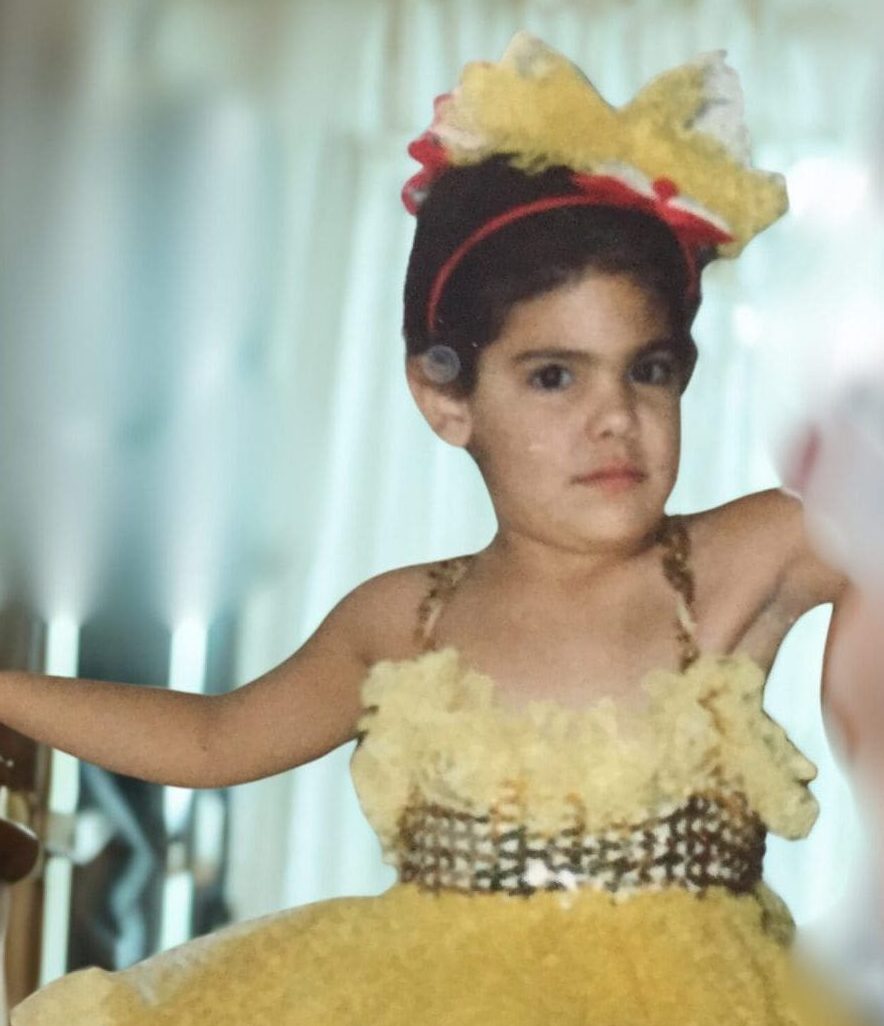

The story we want to believe
There’s a story many families tell themselves:
If we do this right, they’ll be fine.
If we choose opportunities carefully.
If the adults stay close.
If success doesn’t come too fast… or disappear overnight.
It’s not a dramatic hope. It’s steady. Protective, practical. A belief that with enough care, a child can grow up in full view and still arrive in adulthood intact, without having to “undo” what came before.
That hope isn’t naïve. It’s human.
And there’s a question underneath it that doesn’t go away:
Why does seamless feel so necessary to believe?
A moment from my childhood that explains the myth
I was eight, talking about Whitney Houston with a beloved family member.
I was in awe of her… how she could get up there and perform like that, night after night. I said something earnest and childlike and, honestly, pretty beautiful: that she could do it because she felt it so deeply, and the audience was just lucky enough to witness what was in her heart.
My family member shut it down fast.
No. She isn’t doing it for her. She’s doing it for the audience.
You think she wants to get up there every time? No.
You don’t perform for you. You perform for them.
If you want a career in this industry, you need to understand that.
That wasn’t cruelty. It was training.
And it was also a message that lands heavy in a child’s body:
Your inner life is not the point. The outcome is. The audience is. The machine is.
And this is one of the roots of the “seamless transition” myth. Because when children are taught early that performance is for everyone else, seamless becomes the goal that keeps adults comfortable:
No mess. No grief. No reckoning. No “what did it cost?”
Just forward. Just fine.
When growing up happens in public
When a child’s work, talent, or image is public (and often praised), development doesn’t pause. It just happens in front of an audience.
They’re growing while being watched, evaluated, and narrated in real time. Their sense of self isn’t shaped only by what they feel and choose, but by what the world reflects back. Comments, expectations, roles, headlines, and the steady refrain of: You’re so talented.
The real issue isn’t whether a child can grow up healthy in those conditions. Many do.
It’s what happens later, when that public chapter ends.
Because a high-profile childhood doesn’t vanish when the jobs stop. It lingers. It often needs to be processed, understood, and folded into a wider identity – one that can hold success without needing applause to feel real.
Why “seamless” is the wrong goal
The myth of the clean handoff says: if a child succeeds, adulthood will take care of itself.
That career continuity equals inner continuity.
But it skips what matters most.
It skips the private work of making meaning of what happened.
It skips the grief of lost normalcy… lost anonymity, lost room to fail in peace.
It skips the recalibration that often follows early responsibility and constant visibility.
Because continuity isn’t the same as wholeness.
A child can move from role to role without falling apart and still feel split inside. They can stay accomplished while carrying the questions:
Who am I when nobody is watching?
When nobody is clapping?
When I’m not “for them”?
Naming this isn’t about predicting harm. It’s about refusing the pressure to treat adulthood like a prize you earn for performing well as a kid.
Integration isn’t a pivot. It’s a process.
What often gets framed as a “transition problem” is something deeper and more ordinary: development catching up with experience.
Integration takes time because it asks questions that can’t be answered on a schedule:
Who am I beyond what I did?
What choices are truly mine now?
What parts of me were shaped for survival, not preference?
This is why pauses, pivots, and detours can show up not as evidence something went wrong, but as evidence something honest is happening. A system slowing down long enough to feel. An identity renegotiating itself outside momentum.
Two things can be true at once:
- visibility can coexist with fragmentation
- opportunity can coexist with unfinished business
The work isn’t to erase the past or outrun it. It’s to make enough room for meaning to form, without rushing toward the next marker of success.
What adults are actually holding
Parents can’t script how a child integrates their past. But adults can protect the conditions that make integration more possible.
Often, that protection looks like:
- containment when momentum wants to sprint
- steadiness when outcomes feel uncertain
- valuing coherence over continuity
It can also look like holding something children shouldn’t have to hold: the responsibility of making sense of their own history.
Children should never be tasked, explicitly or implicitly, with proving their childhood was “worth it.” They shouldn’t have to carry the burden of justifying what it cost them, or performing gratitude on command.
Meaning-making belongs in adulthood, with time, perspective, and choice.
One of the most protective roles adults play isn’t managing outcomes. It’s guarding the space where identity can settle into something self-directed and whole.
What if success looked different?
What if success weren’t measured by how long a career lasts, or how cleanly it continues, but by whether a person feels at home in their own life?
Stability. Choice. Internal coherence.
The ability to say yes, and especially no, without fear of collapse.
A life that belongs to the person living it.
This consideration doesn’t lower the bar. It widens it.
A successful adulthood isn’t one that proves childhood talent was justified.
It’s one that doesn’t require performance in order to feel real.
A moment to reconsider
If you’re pondering this question, you’re not alone.
You might sit with a few of these, without rushing toward answers:
- What does integration look like in this season, not the next headline?
- Where might slowing down be protective, not risky?
- What would it mean to value coherence over continuity in your family?
Uncertainty here isn’t a problem to solve. It’s often a sign of care.
And if you find yourself wanting space to think, not to fix… this is exactly the terrain I explore with families in coaching: slowly, thoughtfully, with respect for the whole system, not just the visible outcomes.






Read the Comments +